What are the practical use cases of the "Alarm suppression" function in AI-VMD?
- Network Cameras
- Operation
Here is one practical use case. The “Alarm suppression” function is designed to reduce false alarms and excessive detections by allowing detection to occur while suppressing alarms under specific conditions, helping to lower operational burden.
Use case: Monitoring for People Requiring Care
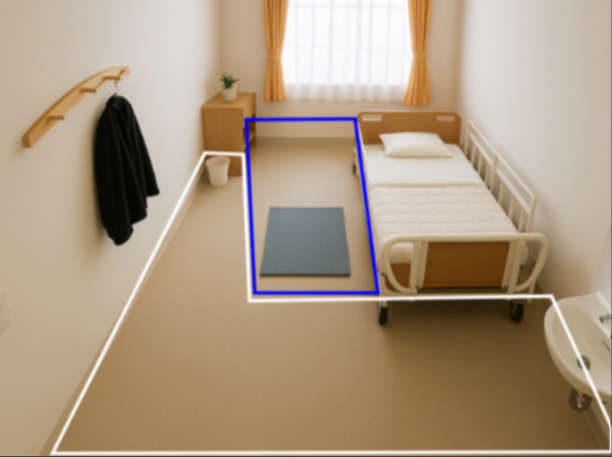
You may want to notify staff when a person requiring care attempts to get out of bed. In this case, the area around the bed can be configured as a “blue area.”
However, alarms may also be triggered when staff enter the room for tasks such as cleaning. To suppress these false alarms, a “white area” can be configured in combination.
Even if a staff member moves from the white area to the blue area, no alarm is triggered while alarm suppression is active.
If a staff member is present in the white area, no alarm is triggered even when the person requiring care enters the blue area, as the situation is already being monitored.
By combining positional relationships between people and specific conditions, it becomes possible to notify only the events that truly require attention.
Summary
The Alarm suppression function is an AI‑VMD feature that leverages advanced detection accuracy and flexible condition settings to reduce unnecessary alarms while ensuring that only truly important alerts are triggered.
Article number:en133206
Last updated:May 28, 2026
Was this article helpful?